
Why I Wrote Busy Bees: The Story Behind My First Science Millie Book
How Busy Bees went from science experiments at home to a real children’s book. 🐝 A behind-the-scenes look at the inspiration, research, and process that brought Science Millie to life and why I wanted to create the kind of STEM book I couldn’t find on the shelf.

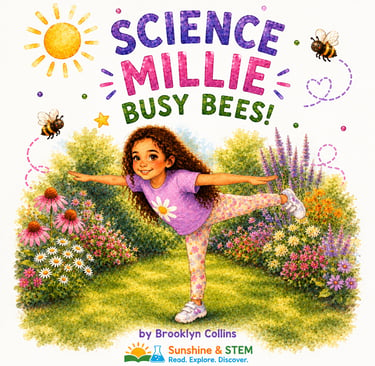
Science Millie started a long time before Busy Bees ever became a real, printed book. The idea grew out of years of doing science with my own kids.
I have a strong love of science, and so do my kiddos. It is a huge part of our household. We do experiments constantly, color mixing, volcanoes, all of it, and I love learning alongside my kiddos just as much as they love playful discovery. Somewhere along the way, I started wanting to write something that captured that: a little kid discovering science in their everyday life, the way my own kids do. Not a textbook character, but someone like them.
That's where Millie came from. I wanted other kids to see a character their age noticing wonder in ordinary things, and then be able to do those same experiments themselves. I've written a handful of Science Millie stories over the years. Busy Bees is the first one I actually published.
Where the idea came together
I've always loved doing yoga with my kids, but I struggled to find yoga books I actually enjoyed using with them. I'd bought a few before, nothing terrible, just kind of a random pose followed by another random pose, with no real thread holding it together. They felt flat. I never really loved doing them.
Then, while I was planning a bee-themed week, movement was on my mind, and it all clicked at once. I wanted a book built around the lifecycle of a bee, something that fit naturally with the kind of lifecycle and nature learning we already loved, paired with yoga poses that actually followed a story instead of floating on their own. I also loved the idea of weaving in how bees work together in a hive, each taking on a different job throughout its life. Cleaning the hive, building the hexagon cells, real jobs, turned into things we could act out together.
I wanted to build the book I couldn't find on the shelf.
Building it from the format up
Once I had the concept, I didn't start with pretty sentences; I started with research. What does it actually take to publish a book? How many pages do I need? What size should it be? I decided on an 8.5" x 8.5" format, so that became my starting point, and everything else got built to fit inside it.
From there, I mapped out the lifecycle stages and the different hive jobs, and thought through which yoga pose would represent each one. I made bullet points for the storyline. I already knew I wanted a layout with the illustration on the left page and the words on the right, clean, simple, the kind of picture book that feels made for little hands. And I knew I wanted watercolor illustrations, because we paint with the kids every single week in my class, and that soft style is exactly the feeling I wanted the book to have.
One thing I'd do differently next time: I wish I'd included an actual lifecycle diagram page in the book itself. I ended up adding that piece into the companion weekly curriculum PDF instead, but it's something I'll build into future books.
Why it matters to me
Busy Bees isn't meant to be a book you read once and shelve. It's built to be lived with, read together, moved through together, and talked about together. We act out the jobs. We do the poses. We talk about what happens at each stage of a bee's life. It's exactly the kind of hands-on, repeatable learning experience I wanted for my own kids, built the way I always wished it existed.
That's really the heart of why I wrote it, not just to publish a book, but to create something my own family would actually want to open again and again.